
 (209) 878-7320
 info@sureguardmattress.com


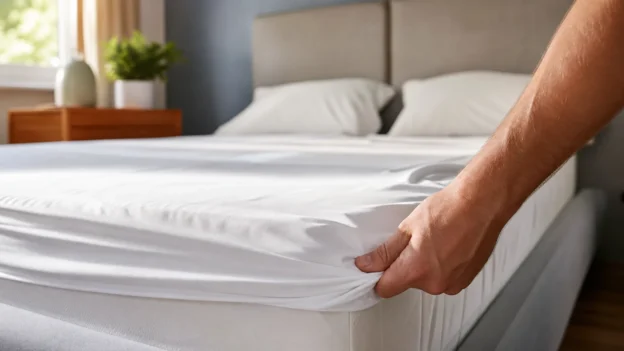
Running a short-term rental means your mattress works harder than almost any household bed. Multiple guests, back-to-back stays, and unpredictable spills create conditions no standard bedroom ever faces. An airbnb rental mattress protector is not a luxury add-on, it’s the single piece of bedding that sits between a clean, warranty-valid mattress and an expensive replacement bill. This guide covers what to look for, why it matters, and how to protect both your asset and your star rating.
Why Every Short-Term Rental Needs a Mattress Protector
The guest turnover problem
A household mattress might see two sleepers for years. A short-term rental mattress can see dozens of different guests in a single month. Each stay brings body oils, sweat, spilled drinks, and the full range of nighttime accidents. That volume compounds fast, fabric that absorbs even small amounts of moisture per stay can develop odors and microbial growth within weeks without a proper barrier.
Hotel housekeeping strips and replaces all bed linen, including mattress protectors, between every guest stay. That practice demands protectors withstand hundreds of wash cycles without delaminating or losing their waterproof barrier. Short-term rental hosts face exactly the same demands, just at a smaller scale.
What’s actually at stake: stains, liability, and warranty voids
An unprotected mattress carries three real financial risks. First, visible stains reduce the mattress’s remaining value to zero, no secondhand sale, no reuse in another property. Second, most major mattress manufacturers state in their warranty terms that stains, regardless of source, can constitute grounds for voiding the warranty. A single uncovered spill during a guest stay can erase thousands of dollars of manufacturer protection. Third, without documented protection in place, a host has little recourse when disputing damage claims with a platform like Airbnb.
A rental property mattress cover removes all three risks at once.
Commercial Grade Bedding Protection vs. Standard Consumer Protectors
What separates hotel-grade from everyday options
Consumer-grade protectors are designed for occasional washing, roughly once a month in a typical home. A hotel grade mattress protector is engineered for something different: industrial laundering, repeated spin cycles, and fast drying between uses, sometimes multiple times per week.
The practical difference shows up in how the waterproof membrane is bonded to the fabric. Budget options use a thin laminate that delaminates after 20–30 washes. Commercial grade bedding protection uses more durable bonding processes so the barrier stays intact across hundreds of cycles. The fabric facing matters too. A crinkly, plastic-feeling surface gets noticed immediately by guests and generates complaints. A well-made product uses a breathable cotton top that sleeps quietly and comfortably.
Key specs to look for in a rental property mattress cover
When evaluating a rental property mattress cover for short-term rental use, these are the specs that matter:
- 100% waterproof barrier, not water-resistant, not splash-resistant. Fully waterproof.
- Cotton top surface, quiet, breathable, and comfortable enough that guests don’t notice it.
- Hypoallergenic fill, guests have varied sensitivities; an allergen-free product reduces complaints and liability.
- Machine-washable at standard residential temperatures, you’ll be washing it between every stay.
- GREENGUARD Gold or equivalent certification, independent verification that the materials off-gas no harmful chemicals.
For a deeper comparison of barrier technologies, see waterproof mattress cover options explained.
Waterproof Mattress Protection: The Non-Negotiable Feature for Rentals
Waterproof mattress protection is the baseline requirement for any rental property, not a premium feature to weigh against alternatives. A water-resistant protector slows liquid absorption; it does not stop it. Once moisture reaches mattress foam or springs, the damage is done: odors set in, mold can develop in the core, and the structural integrity of the foam degrades over time.
A fully waterproof barrier stops liquid completely at the surface. The mattress underneath stays dry regardless of what happens on top. That matters for the mattress’s longevity, for hygiene between guest stays, and for the confidence of knowing the bed you’ve made up is genuinely clean.
GREENGUARD Gold certification adds another layer of assurance. It means the protector has been independently tested and verified to emit no harmful chemicals, an important guarantee when guests with different sensitivities are sleeping on a bed they did not choose themselves. When strangers sleep in your property, materials that meet objective third-party standards matter more than manufacturer claims alone.
For hosts considering full enclosure coverage, a guest proof mattress encasement takes this protection further by sealing all six sides.
Protecting Your Mattress Warranty, and Your Guest Reviews
Most mattress warranties run 10 years or longer. They cover manufacturing defects, but nearly every major brand includes a clause stating that stains void the warranty, regardless of how the stain occurred. That clause is not a technicality; manufacturers enforce it. Without a protector, one guest accident removes that coverage permanently.
A protector closes that gap entirely. As long as the mattress surface stays stain-free, the warranty remains intact. For hosts who’ve invested $500–$1,500 in a quality mattress, a $50–$80 protector is straightforward financial logic. For a detailed look at how warranty terms compare across products, the mattress protector warranty comparison breaks it down clearly.
The guest review angle is equally practical. Short-term rental guests notice the bed before almost anything else. A mattress that carries old odors or feels slightly damp translates directly into lower star ratings. A fresh, odor-free, clean-feeling bed does the opposite. Hosts who protect their mattresses from day one consistently maintain the kind of bedding quality that earns five-star reviews. The protector is invisible to guests when it’s working correctly, and that invisibility is the goal.
How to Choose the Right Airbnb Rental Mattress Protector
Encasement vs. fitted-style protector: which suits rentals best?
Fitted-style protectors cover the top and sides of the mattress, held in place by an elasticated skirt. Although they only protect the top of the mattress, they’re fast to remove and replace, which is important when you have a two-hour turnover window between checkout and the next check-in.
Encasements zip around all six sides of the mattress, forming a complete seal. They protect against bed bugs in addition to liquid and allergens, a significant advantage for urban rentals in high-traffic cities where bed bug risk is real. The trade-off is slightly more time to install and remove. For detailed guidance on that decision, see the full mattress encasement guide and bed bug protection for rental properties.
For most hosts, a fitted-style waterproof protector is the practical daily-use choice, with an encasement underneath as a permanent base layer in higher-risk locations.
Sizing, care, and how many sets to stock
Buy protectors that match your exact mattress depth, most short-term rental beds run 10–14 inches deep, and a protector that fits poorly bunches up and gets noticed by guests.
On quantity: property managers who oversee multiple short-term rental units consistently recommend keeping a minimum of two protectors per bed. One stays on the mattress; the second is clean and ready to swap in immediately after checkout. This removes the mattress from the laundry critical path, you can make the bed with a fresh protector while the used one is still in the wash. For hosts running back-to-back same-day turnovers, two per bed isn’t optional. It’s the only way to guarantee the mattress is never left unprotected between stays.
Wash protectors after every guest stay, not just when they look soiled. Follow the care label exactly, high heat can damage waterproof membranes on some products. For step-by-step guidance, how to wash a mattress protector correctly covers the full process.
If you’re still working through the broader buying decision, how to choose the right mattress protector offers a complete framework.
SureGuard for Short-Term Rental Hosts: What to Know
SureGuard’s mattress protectors are built to the standard that rental hosts have relied on for years. The flagship protector is 100% waterproof, features a pure cotton top surface that sleeps quietly and comfortably, and carries GREENGUARD Gold certification, independently verified, not self-reported. The GREENGUARD Gold certified mattress protector benefits page explains what that certification covers and why it matters for guest safety.
The 10-year warranty means it’s built to last well beyond any reasonable rental cycle. With a 4.6-star average from more than 45,000 ratings, the performance holds up across a wide range of real-world conditions, not just controlled household use.
For short-term rental hosts, that track record matters. You’re not buying a protector for yourself; you’re buying it for every guest who will sleep in your property over the next several years. Consistent, certified, independently verified quality is what responsible hosting looks like in practice.
SureGuard’s waterproof mattress protector is available in all standard sizes. Rest assured with SureGuard.

