
 (209) 878-7320
 info@sureguardmattress.com


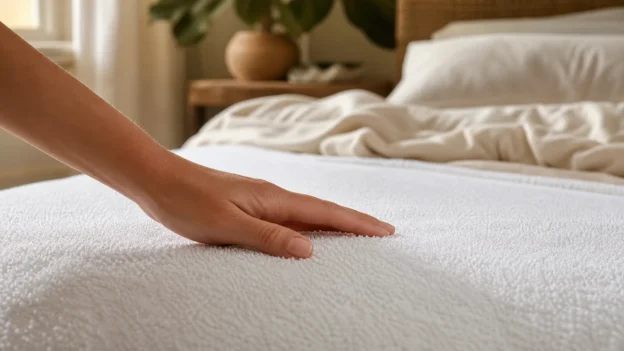
If you’ve ever slept on a plastic or vinyl mattress protector, you know the downsides immediately. The crinkle when you shift positions. The clammy warmth that builds up overnight. Cotton terry mattress protector benefits solve exactly those problems, delivering a surface that feels like bedding rather than a rain jacket. Understanding why cotton terry outperforms plastic and vinyl helps you make a smarter, longer-lasting buying decision.
What Makes Cotton Terry Different from Other Mattress Protector Materials
The anatomy of a cotton terry weave
Terry cloth gets its signature softness from a looped-pile construction. During weaving, extra yarn is left in small, raised loops on the surface rather than lying flat. Those loops dramatically increase the fabric’s surface area, which is why terry absorbs moisture so well, it’s the same principle behind a quality bath towel.
In a mattress protector, that looped surface sits between you and the mattress. It wicks away body moisture, cushions gently against your skin, and stays quiet when you move. The loops also allow air to circulate through the fabric, which matters a great deal once you’re under the covers for eight hours.
How terry cloth compares to plastic and vinyl surfaces
Plastic and vinyl protectors use a solid, impermeable film as both the waterproof layer and the sleep surface. That works for waterproofing, but it creates two well-known problems.
First, the material traps heat. There’s no airflow through a solid film, so body heat pools at the surface. Second, the stiffness produces an audible crinkling sound with every movement, a consistent complaint from sleepers who’ve tried vinyl-coated options. Cotton terry’s looped-pile surface eliminates both issues, giving you a soft, quiet, breathable waterproof mattress cover without the sensory trade-offs.
The Comfort and Breathability Benefits of a Cotton Terry Mattress Protector
Temperature regulation and airflow
Natural cotton fibers are hygroscopic, they absorb and release moisture as conditions change. When you perspire during sleep, a cotton terry surface draws that moisture away from your skin and allows it to evaporate rather than pooling. A vinyl or plastic surface has no such mechanism; moisture stays trapped at the contact point.
Sleep health guidance consistently notes that a cooler, drier sleep surface supports deeper, less interrupted sleep. That’s why natural fiber surfaces like cotton terry are recommended over synthetic alternatives for everyday use. A breathable waterproof mattress cover achieves what vinyl cannot: genuine protection and genuine airflow in the same product.
Soft sleep surface you actually notice
The softness of terry cloth bedding protection is noticeable from the first night. Where a plastic-backed protector feels rigid and smooth in a way that conflicts with your sheets, a cotton terry surface blends in, it feels like an extension of your bedding rather than a separate layer.
That noiseless, non-clammy quality is particularly valuable for light sleepers and for anyone sharing a bed. No crinkle on every turn. No sweaty film at 3 a.m. Just a soft mattress protector that does its job without announcing itself.
Waterproof Protection Without the Plastic Feel: How Cotton Terry Delivers Both
The most common misconception about cotton terry protectors is that softness and waterproofing are a trade-off. They’re not, and the construction explains why.
A quality cotton terry mattress protector uses a two-layer design: a pure cotton terry top surface for comfort, paired with a thin, separate waterproof membrane backing. The membrane, typically a TPU (thermoplastic polyurethane) film, handles liquid protection. The cotton terry handles the sleep surface. Neither layer has to compromise.
SureGuard’s cotton terry mattress protector uses exactly this construction: a pure cotton terry top paired with a waterproof membrane backing. The result is a protector that guards against spills, accidents, and moisture without ever feeling like plastic beneath your sheets.
The cotton vs plastic mattress protector debate often assumes you must sacrifice one for the other. In practice, a well-made terry protector with a TPU membrane gives you both, real waterproofing, real softness, real breathability.
Health and Allergen Benefits of Terry Cloth Bedding Protection
Hypoallergenic properties and certifications
Cotton is naturally hypoallergenic, meaning it’s unlikely to trigger skin reactions or respiratory sensitivities on its own. But the health case for cotton terry goes beyond the fiber itself, it comes down to what the breathable surface prevents from accumulating over time.
Third-party certification matters here. GREENGUARD Gold certification independently verifies that a product meets strict limits on chemical emissions, confirming it’s safe for use in homes with children and sensitive sleepers. SureGuard’s mattress protector carries this certification, which means no harmful off-gassing from the protector’s materials, something a cheap vinyl product cannot always guarantee.
Protecting against dust mites, mold, and spills
Dust mites and mold share a common requirement: moisture and warmth. A plastic or vinyl surface traps heat and perspiration at the mattress level, creating exactly the conditions those allergens need to thrive. Cotton terry’s airflow and moisture-wicking properties work against that environment.
A breathable protector keeps the microclimate at the mattress surface drier and cooler night after night. For households with allergy sufferers, that ongoing reduction in trapped moisture is meaningful. Pair that with waterproof protection against liquid spills, and you’re also blocking the most direct route for mold to take hold in a mattress. For readers managing specific sensitivities, the best mattress protector for allergies and mold-resistant mattress protector features can help narrow the decision further.
Durability and Longevity: Why Cotton Terry Holds Up Over Time
One practical concern with any mattress protector is how it holds up through repeated machine washing. A protector that degrades after a year of regular laundering isn’t protecting your mattress, or your investment.
Cotton terry handles washing well because the looped-pile structure is resilient. The fibers flex and recover rather than cracking under stress. Compare that to vinyl-coated alternatives, where the solid film layer is prone to cracking and delaminating with heat and mechanical stress from the wash cycle. Once the vinyl cracks, the waterproof barrier fails.
A TPU membrane backing, the type used in well-made cotton terry protectors, is far more flexible and durable through wash cycles than rigid vinyl. It stretches with the fabric rather than pulling away from it.
SureGuard backs its cotton terry protectors with a 10-year warranty. That’s a practical signal: a company confident in how its product holds up through years of regular machine washing is willing to stand behind it for a decade. Most budget vinyl-backed options carry no meaningful warranty at all. If you’re weighing value against upfront cost, an affordable waterproof mattress protector doesn’t have to mean sacrificing that kind of durability.
SureGuard has been manufacturing mattress protectors since 2013 and holds over 45,000 customer reviews across all products on Amazon, with an average rating of 4.6 out of 5 stars, a consistent real-world signal that the comfort and durability hold up past the first few nights.
How to Choose the Right Cotton Terry Mattress Protector
Key features to look for
Not every product labeled “cotton terry” delivers the same performance. When evaluating options, look for these specifics:
- Top surface material: Should be 100% cotton terry, not a blend that dilutes the natural fiber benefits.
- Waterproof backing type: TPU membrane outperforms vinyl for both durability and breathability. Vinyl cracks; TPU flexes.
- Certifications: GREENGUARD Gold is the most meaningful independent certification for chemical safety in sleep products. OEKO-TEX Standard 100 is another credible standard worth noting.
- Machine washability: The protector should be fully machine washable.
- Warranty length: A 10-year warranty signals genuine confidence in durability.
For a fuller breakdown of what separates quality options from budget alternatives, the guide on key features to look for in a mattress cover covers these criteria in depth.
Sizing, fit, and care tips
Fit matters as much as materials. A protector that shifts during the night, or bunches under your sheets, undermines both comfort and protection.
Look for deep pocket sizing that matches your mattress depth. Standard mattresses typically run 10–12 inches deep, but pillow-top and hybrid mattresses can reach 14–18 inches. Confirm the pocket depth before buying.
For care, machine wash in cool to warm water (not hot) and tumble dry on low. High heat can stress both the cotton fibers and the waterproof membrane over time. Always check the product’s specific care label, and for more detailed instructions, how to wash a mattress protector correctly walks through the full process.
For readers still working through the broader decision, how to choose a mattress protector provides a structured framework across all protector types.
The case for cotton terry mattress protectors is straightforward: a surface that breathes, wicks moisture, stays soft and quiet, and holds up through years of washing, none of which a plastic or vinyl alternative can match. A pure cotton terry top with a TPU waterproof membrane means you’re not trading comfort for protection. You’re getting both.
SureGuard’s cotton terry mattress protector is GREENGUARD Gold certified, backed by a 10-year warranty, and rated 4.6 stars across tens of thousands of verified reviews. That’s a low-risk way to protect your mattress and your family’s health for the long term.

