
 (209) 878-7320
 info@sureguardmattress.com


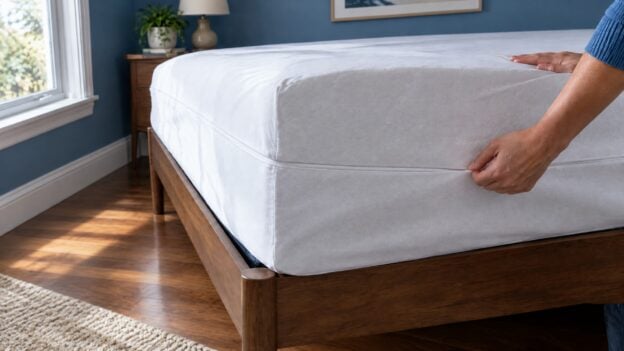
Yes, a mattress cover can help with bed bugs, but only the right kind, and only as one part of a plan. A full encasement traps bugs already inside the mattress and blocks new ones from getting in. It does not kill an infestation on its own.
That distinction matters if you are mid-problem, or just back from a trip and worried. This guide covers how an encasement works, how to fit and install one, and what else to do around it. It also covers when to stop doing it yourself.
How a bed bug mattress cover traps bugs and blocks new ones
A full encasement wraps the whole mattress and closes with a zipper, so bugs inside have no way out and bugs outside have no way in. Trapped bugs lose access to a blood meal. They can still survive a long time without feeding, in some cases many months, so the cover works as a barrier and not as a treatment.
SureGuard Mattress and Box Spring Encasements offer six-sided protection against liquids, stains, allergens and bed bugs, aimed at households that want a fully sealed sleep environment.
Why a full encasement blocks bugs where a partial cover does not
A fitted-sheet-style protector covers the top and sides but leaves the underside open. Bed bugs need only a small gap, so any open seam becomes a doorway in or out. A standard protector is built for spills and stains, and it can still be a good buy for that job.
An encasement closes on every side. If you are unsure which one you have, our comparison of protector or encasement: which one fully encloses the bed lays out the difference. For a closer look at the trapping logic, read how encasements stop an infestation from spreading.
Whether a mattress encasement kills bed bugs or traps them
It traps them. Nothing on its own reliably kills every bed bug. Heat does the killing: hot-water laundering, high-heat drying, or a professional treatment.
So the encasement and the heat steps do different jobs. One holds the line while the other removes the bugs. Treat a cover as a guarantee and you will be disappointed. Treat it as one layer next to inspection and laundering, and it earns its place.
That is also how integrated pest management practice frames it: the encasement sits alongside inspection, laundering, vacuuming and professional treatment, not in place of them.
Choosing the right size and depth for your bed
Encasements are sized by mattress depth, not just by bed size. A cover that is too shallow will not close around the mattress, and a gap defeats the purpose. A cover that is far too deep leaves slack that is easy to snag.
Measure mattress depth before you choose a cover
Measure length, width and depth with a tape measure. Take the depth from the bottom edge to the highest point of the top, and include any pillow top. Mattresses compress and puff in different places, so measure at a couple of spots and use the larger figure.
Then match your reading to a depth band. A queen bed that measures 17 to 20 inches deep fits the Queen (17-20 in. Deep) SureGuard Mattress Encasement, which costs around USD 64.97. A twin bed that measures 13 to 16 inches deep fits the Twin (13-16 in. Deep) SureGuard Mattress Encasement. Check each product page for current pricing and any other depth options.
If your measurement lands on the edge of a band, go by the deeper reading. The cover has to fully enclose the mattress, with the zipper closing without strain.
How to use a bed bug mattress encasement, step by step
The order matters. If you encase a bed that still has bugs on the surface or in the bedding, you may seal them in with a fresh food source, or carry them to the next room.
Work through the steps below in sequence, and finish the whole bed in one go.
Signs of bed bugs in the mattress to check first
Strip the bed and look closely along the piping, tags and seams. Check the corners and the headboard too. Here is what to look for:
- Dark specks along seams, which are bug droppings
- Shed skins, which look like pale, papery shells
- Small pale eggs tucked into folds and crevices
- Rust-colored stains on sheets or fabric
Even one live bug is reason to act now. You do not need a visible colony to start the process.
One more point, because it worries people. Most infested mattresses can be cleaned, treated and kept. Replacing the mattress is rarely the first step, and a new one brought into an untreated room can pick up the same problem.
Wash, dry, vacuum, then encase the mattress
Once you have inspected, move in this order:
- Wash sheets, blankets, pillowcases and mattress pads in hot water, then dry them on high heat. The drying is what does the killing, so do not skip it or cut it short. Do not dry SureGuard products on high heat, as it will damage the protective backing.
- Vacuum the mattress, the box spring and the bed frame. Go slowly along seams, tufts and joints, then empty the vacuum outside in a sealed bag.
- Slide the encasement over the mattress. It is easier with two people, one lifting each end.
- Close the zipper fully and check that no fabric is caught in the teeth.
The seal only works while the fabric is intact and the closure stays shut. Check the zipper and seams now and then, and patch or replace the cover if it tears. Because small tears are easy to miss, run your hand along the edges whenever you change the sheets.
Encase the box spring along with the mattress
If you seal the mattress and leave the box spring open, you have fixed half the bed. An infestation can carry on underneath, and the bugs will find their way back up. Your sealed mattress is only as safe as what sits under it.
Why an open box spring leaves a hiding place
A box spring is a wooden frame with fabric stapled to the underside, and that underside often has gaps and folds. It is a common hiding place, and it keeps an infestation going even when the mattress above is sealed. Encasing both removes the two biggest hiding spots in the bed.
For a queen bed, the Queen Size SureGuard Box Spring Encasement costs around USD 64.97. SureGuard also has box spring encasements in twin, twin XL, full, full XL and split king sizes. If you want more on coverage and fit, there is a full guide to box spring encasements.
How long to leave a bed bug encasement on
Leave it on well past the last sign of bugs. Trapped bugs can survive a long time without feeding, so removing the cover early can release ones that are still alive.
A calm rule: do not take it off just because the bed looks clean for a few weeks. Many people simply leave it on for good. Once the bed is clear, the cover keeps working as ongoing protection, and it keeps guarding against spills, stains and allergens as well.
This is not a quick fix. If you are hoping to zip the cover on and see the problem vanish by the weekend, it will not happen that way.
Bed bug prevention for dorms, travel and rental properties
Bed bug prevention in the bedroom comes down to routine. The encasement is one layer. It does not replace checking the bed, and it will not help with a bag that has been dropped on an infested floor.
Bed bug protection after travel
Bed bugs travel in luggage and clothing, so the habits that matter start at the hotel. A typical routine after a hotel or rental stay looks like this: unpack away from the bed, check the mattress seams and headboard before sleeping, and keep your bags off the bed and off upholstered furniture.
When you get home, wash the trip clothing in hot water and dry it on high heat. Do this before the clothes go back into your drawers. If you find a bug, deal with it at once, before it has time to settle into your bedroom.
Bed bug protection for rental property and dorm rooms
Shared and rented beds change hands often, so each change of occupant is the moment to inspect. Consider a typical dorm case: a bed frame moved from one room to another can carry bugs with it. Checking the frame and the mattress seams before the bed is made up matters most.
If you rent, you can encase a mattress and box spring you do not own, since the cover comes off cleanly when you move out. It gives you a barrier whatever the bed’s history. For treatment, check your lease and local rules, because in many rentals the landlord or property manager arranges and pays for pest control. Report a sighting in writing as soon as you spot it.
For a wider look at features and fit, see what to look for when buying a bed bug cover.
When to call a pest professional
A cover is one step, and it has limits. If bugs show up beyond the bed, such as in the sofa, the baseboards or the curtains, you are past what an encasement can handle. The same goes if they keep coming back after careful washing, vacuuming and encasing.
At that point, bring in a licensed pest professional. Getting rid of bed bugs in a mattress and the room around it usually needs treatment a cover cannot give. Skip the foggers, because they tend to scatter bugs into new rooms instead of killing them, and the US Environmental Protection Agency says the same about over-the-counter foggers.
Keep the encasement on while the professional works. It holds the bed steady during treatment, and a bed that is already sealed is easier to keep clear afterwards. This is general guidance, not a substitute for a pest professional’s assessment of your home.
Frequently asked questions
Is there a bed bug proof mattress cover?
A full encasement that closes on every side traps bugs inside and blocks new ones, but no cover is a guarantee. It only works while the fabric is intact and the zipper stays fully closed. Use it with inspection, and, if needed, professional treatment.
What kills bed bugs 100%?
Nothing on its own reliably kills every bed bug. Heat is what kills them: hot-water washing followed by high-heat drying for fabrics, and professional treatment for the room. An encasement traps and blocks them, but it does not kill them quickly.
I found two bed bugs in my bed. Should I be worried?
Take it seriously, but stay calm. Even one live bug is reason to act now, because there are usually more hiding in seams, the box spring or the frame. Inspect the bed, wash and heat-dry the bedding, vacuum, encase the mattress and box spring, and call a licensed pest professional if you see bugs elsewhere.
Do I need to throw away my mattress if I have bed bugs?
Usually not. Most infested mattresses can be cleaned, treated and kept, so replacing one is rarely the first step. A new mattress placed in an untreated room can pick up the same problem.

